Biological Classification

Bacterial diseases – Humans and Plants

Bacterial Diseases Information Bacterial Diseases Information Human Bacterial Diseases Tuberculosis (तपेदिक) Causation Bacteria: Mycobacterium tuberculosis…

READ LESSON

Biological Classification NCERT Revision by Sidd Sir

Interactive Notes: Biological Classification Biological Classification Understanding the Diversity of Life The Need for Classification…

READ LESSON

Kingdom Monera -NCERT-NEET-Bacteria are the sole members of the Kingdom Monera. They are the most abundant micro-organisms. Bacteria occur almost everywhere. Hundreds of bacteria are present in a handful of soil. They also live in extreme habitats such as hot springs, deserts, snow and deep oceans where very few other life forms can survive. Many of them live in or on other organisms as parasites

General Characteristics of Monera General Characteristics Kingdom Monera: Bacteria Bacteria are the sole members of…

READ LESSON

NCERT-NEET-A mycorrhiza is a symbiotic association of a fungus with a root system.

Mycorrhiza and Plant Symbiosis Table Aspect Details Symbiotic Association Mycorrhiza is a symbiotic relationship between…

READ LESSON

NCERT-NEET-Bacteria are the sole members of the Kingdom Monera. They are the most abundant micro-organisms. Bacteria occur almost everywhere. Hundreds of bacteria are present in a handful of soil. They also live in extreme habitats such as hot springs, deserts, snow and deep oceans where very few other life forms can survive. Many of them live in or on other organisms as parasites

Category Description General Characteristics Bacteria are the sole members of Kingdom Monera. They are the…

READ LESSON

NEET-NCERT-In Linnaeus’ time a Two Kingdom system of classification with Plantae and Animalia kingdoms was developed that included all plants and animals respectively. This system did not distinguish between the eukaryotes and prokaryotes, unicellular and multicellular organisms and photosynthetic (green algae) and non-photosynthetic (fungi)organisms. Classification of organisms into plants and animals was easilydone and was easy to understand, but, a large number of organisms did not fall into either category. Hence the two kingdom classification used for a long time was found inadequate. Besides, gross morphology a need was also felt for including other characteristics

Classification System Kingdoms Included Description Basis of Classification Very Early Classification – Non-scientific. Was done…

READ LESSON

NCERT-NEET-In the five kingdom classification of Whittaker there is no mention of lichens and some acellular organisms like viruses, viroids and prions. These are briefly introduced here.

Type Characteristics Viruses – Non-cellular organisms with inert crystalline structure outside the living cell. –…

READ LESSON

NCERT-NEET-The morphology of the mycelium, mode of spore formation and fruiting bodies form the basis for the division of the kingdom into various classes.

Fungal Classes Comparison Characters Phycomycetes Ascomycetes Basidiomycetes Deuteromycetes Habitat Aquatic habitats, decaying wood in moist…

READ LESSON

The fungi constitute a unique kingdom of heterotrophic organisms. Theyshow a great diversity in morphology and habitat.

Kingdom Fungi Aspect Details Introduction The fungi constitute a unique kingdom of heterotrophic organisms showing…

READ LESSON

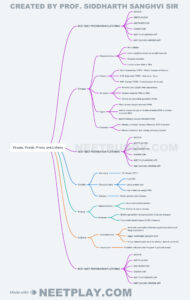
Concept Map on Protista by Prof. Siddharth Sanghvi Sir for NEET

Responsive Table Characteristics of Unicellular Eukaryotes Unicellular eukaryotes Primarily aquatic Link between plants (Algae), fungi,…

READ LESSON
1 2