pre-class

LIVING WORLD-TWO WORLDS STYLING

Living World Notes – Style 1 LIVING WORLD Table of Contents Living World: Characteristics of…

READ LESSON

Living World-NCERT -PRE CLASS CONTENT for NEET by Sidd Sir

The Living World – Notes Style 6 The Living World Table of Contents: Key Concepts…

READ LESSON

Understanding Polymorphic & Pleomorphic Nature of Lysosomes and Golgi Apparatus

Polymorphic Lysosomes Poly = many, morphic = forms Exist in different forms within the same…

READ LESSON

Understanding Polymorphic & Pleomorphic Nature of Lysosomes and Golgi Apparatus

Polymorphic Lysosomes Poly = many, morphic = forms → having many forms Lysosomes are polymorphic…

READ LESSON

G0 Stage – Some cells in the adult animals do not appear to exhibit division (e.g., heart cells) and many other cells divide only occasionally, as needed to replace cells that have been lost because of injury or cell death. These cells that do not divide further exit G1 phase to enter an inactive stage called quiescent stage (G0) of the cell cycle. Cells in this stage remain metabolically active but no longer proliferate unless called on to do so depending on the requirement of the organism

🧬 G₀ Phase – Quiescence in the Cell Cycle In adult animals, not all cells…

READ LESSON

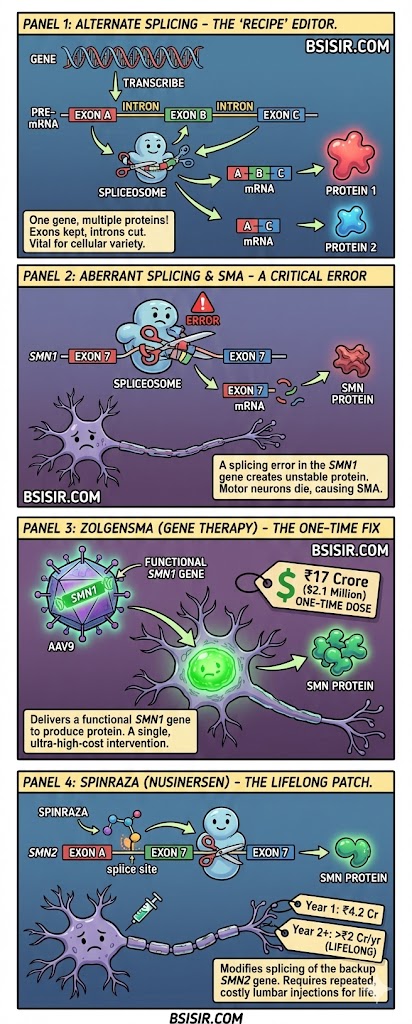
Alternate Splicing – The Secret Language of Genes – A Molecular Mechanism for Diversity Beyond the Genome

Alternate Splicing: Expanding Human Complexity 🔬 Alternate Splicing Expanding Human Complexity Beyond the Genome The…

READ LESSON

A gene is defined as the functional unit of inheritance.The DNA sequence coding for tRNA or rRNA molecule also define a gene.Inheritance of a character is also affected by promoter and regulatory sequences of a structural gene. Hence, sometime the regulatory sequences are loosely defined as regulatory genes, even though these sequences do not code for any RNA or protein. The DNA sequence coding for tRNA or rRNA molecule also define a gene

What is a Gene? A gene is the functional unit of inheritance. It carries the…

READ LESSON

Bacteria like E. coli divide every 20 minutes. But their DNA — about 4.6 million base pairs — takes about 38 minutes to replicate at 2000 base pairs per second. So how do they manage it?

🧬 The DNA-Time Dilemma Bacteria like E. coli divide every 20 minutes. But their DNA…

READ LESSON

Kingdom Monera -NCERT-NEET-Bacteria are the sole members of the Kingdom Monera. They are the most abundant micro-organisms. Bacteria occur almost everywhere. Hundreds of bacteria are present in a handful of soil. They also live in extreme habitats such as hot springs, deserts, snow and deep oceans where very few other life forms can survive. Many of them live in or on other organisms as parasites

General Characteristics of Monera General Characteristics Kingdom Monera: Bacteria Bacteria are the sole members of…

READ LESSON

Mesosomes are in the form of vesicles, tubules and lamellae

Difference between Forms of Mesosomes – Lamellae and Tubules Difference between Forms of Mesosomes –…

READ LESSON
1 2 3 12